



For most Arizona businesses on a standard 2–5 year commercial lease, an office furniture subscription costs less over the full lease term than purchasing outright, and requires $0 upfront versus $40,000–$75,000 at signing. That said, purchasing is the right call in specific situations. This guide gives you an honest comparison so you can make the right decision for your business.
Having furnished more than 1,833 desks and 26,923 chairs across the Phoenix metro, we’ve seen both paths play out in real time. Here’s what the numbers actually look like.
What Does a Tenant Representative Do for You? A Complete Guide

What Is an Office Furniture Subscription?
An office furniture subscription is a fixed monthly fee that covers a complete commercial furniture package, including desks, chairs, conference tables, storage, and common area pieces, along with professional delivery, installation, and end-of-term removal. No capital purchase. No disposal at lease end.
Subscriptions are structured to align with your commercial lease term. If you sign a 3-year lease in Scottsdale or Gilbert, your furniture subscription runs 3 years. When the lease ends, Easy Spaces handles removal. The furniture situation closes cleanly with no liquidation, no storage, and no end-of-term fees.
Easy Spaces provides office furniture subscriptions to Phoenix metro businesses starting at $500 per month, scaled to office size and headcount.
Subscription vs. Purchase: Side-by-Side Comparison
| Category | Traditional Purchase | Easy Spaces Subscription |
|---|---|---|
| Upfront cost | $25,000 – $75,000 | $0 |
| Monthly cost | $0 (capital already spent) | $500 – $2,000/month |
| Delivery timeline | 6 – 12 weeks (industry standard) | 48 – 72 hours |
| Installation | $2,000 – $8,000 additional | Included |
| Reconfiguration | $1,500 – $5,000 per change | Included |
| End-of-lease disposal | $3,000 – $15,000 | Included — zero cost |
| Flexibility | Fixed — you own the asset | Add, swap, or scale anytime |
| Tax treatment | Depreciated capital asset (typically 7-year schedule) | 100% deductible operating expense |
| Capital preserved | No — tied up in depreciating asset | Yes — deploy toward hiring or growth |
| Estimated 3-year total (20-person office) | ~$70,500 | ~$50,400 |
3-year total based on mid-range Phoenix metro office: $55,000 furniture purchase + $4,500 installation + $6,000 two reconfigurations + $5,000 disposal versus $1,400/month subscription x 36 months, all-inclusive.
Get a subscription quote for your Arizona office – 24-hour turnaround →
The Cash Flow Argument
When you sign a commercial lease in Phoenix, you’re already deploying significant capital before your team walks in the door: security deposit, first and last month’s rent, and often tenant improvement buildout costs. That’s typically $15,000–$40,000 out the door before the space is move-in ready.
Layering a $40,000–$75,000 furniture purchase on top of that creates a cash crunch that constrains hiring, technology investment, and operations in the months immediately following the move, the months when a growing company needs capital most.
The subscription model converts that capital expenditure into a predictable operating expense. Your furniture cost becomes a fixed monthly line item, fully deductible as a business expense in the year it’s incurred rather than depreciated over a 7-year capital schedule. The capital you preserve at signing can fund two or three new hires, a full marketing push, or six months of operating reserve.
A 20-person Phoenix-area company that subscribes rather than purchases preserves an average of $45,000–$60,000 in operating capital at the time of the move.
What we see in the field: The businesses that regret purchasing are almost always the ones that grew faster than expected. A company that furnishes 20 workstations in January and needs 30 by September owns furniture that no longer fits their space — and faces a reconfiguration cost on top of a purchase they already made. Subscription clients in that situation call us, we add 10 workstations, and the monthly rate adjusts. No capital decision required.
When Buying Office Furniture Still Makes Sense
This is where most vendor comparisons go wrong; they bury the cases where purchasing is the better call, or skip them entirely. We won’t do that.
Purchasing makes clear financial sense in these specific scenarios:
You own your commercial building. If you own the property and have no plans to relocate in the next 7+ years, the long-term economics of ownership favor purchase. The depreciation schedule works in your favor and there’s no end-of-lease disposal event to plan for.
You’re furnishing a very small, stable space. A 2–3 person executive suite with no growth plans has limited reconfiguration exposure. The subscription’s flexibility premium may not be worth the monthly cost at that scale. Purchasing a small, simple package can make sense.
You have highly specific custom requirements. If your brand standards require custom-fabricated pieces, proprietary finishes, or furniture specifications that fall outside standard commercial packages, purchasing is likely your only option. Subscription packages are commercial-grade and flexible, but they’re not bespoke.
You have centralized purchasing agreements. Franchise operators and corporate entities with existing national furniture contracts may be locked into purchase arrangements regardless of the economics.
Outside these four scenarios, particularly for businesses operating under standard 2–5 year commercial lease terms, the 3-year cost analysis consistently favors subscription.
What’s Included in an Easy Spaces Subscription
A common question we get: “What exactly am I paying for each month?”
Every Easy Spaces subscription includes:
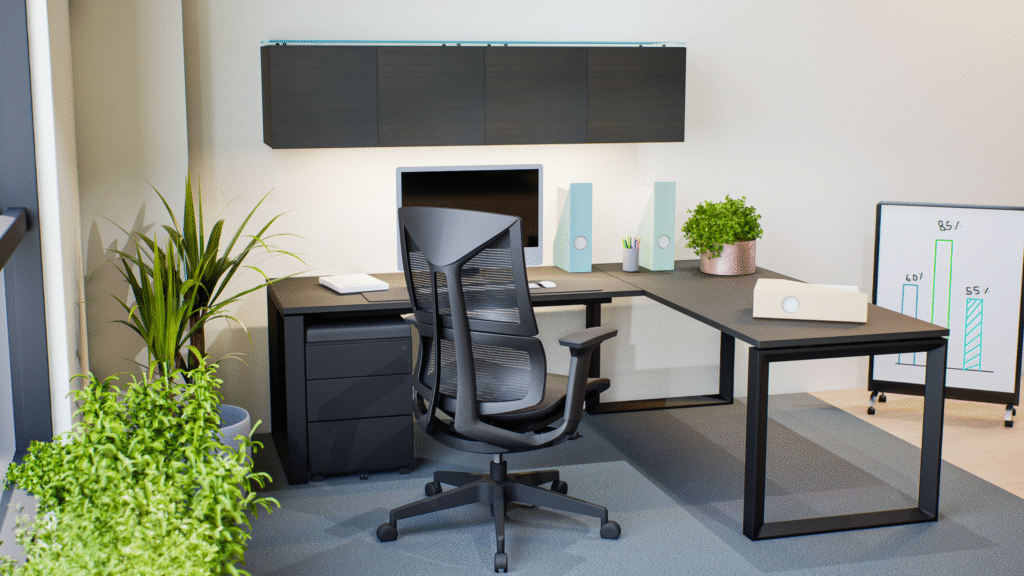
- Complete workstation setup per employee: desk, ergonomic chair, storage unit, and power access
- Conference and meeting room furniture matched to room size and headcount
- Reception and common area pieces where applicable
- Professional delivery and white-glove installation by our Arizona team
- Reconfiguration support for your headcount or layout changes
- Full removal and logistics at the end of subscription term — no disposal cost, no operational burden
Turnaround from approval to a fully furnished office is 48–72 hours for most Phoenix metro locations. The industry standard from traditional commercial vendors is 6–12 weeks. For a business that just signed a lease and needs to be operational, that timeline difference is significant.
The Easy Spaces 3-Year Cost Model
After furnishing hundreds of offices across the Phoenix metro, we built a simple framework to help businesses compare paths accurately, because most purchase quotes only show the furniture line item, not the real total cost over a lease cycle.
The Total Office Furniture Cost formula:
Purchase Path Total = Furniture cost + Installation + Reconfigurations (over lease term) + Disposal at end of lease
Subscription Path Total = Monthly rate × Lease months (installation, reconfiguration, and removal all included)
For a 20-person Scottsdale or Gilbert office on a 3-year lease, that math typically looks like this:
| Purchase | Subscription | |
|---|---|---|
| Furniture | $55,000 | — |
| Installation | $4,500 | Included |
| 2 reconfigurations | $6,000 | Included |
| End-of-lease disposal | $5,000 | Included |
| Monthly payments (36 mo.) | — | $50,400 |
| Total 3-year cost | $70,500 | $50,400 |
| Capital required at signing | $59,500 | $0 |
Not sure what the numbers look like for your specific office? Use our Office Budget Calculator to run the comparison for your square footage and headcount.
Is a Subscription Right for Your Business?
Three questions that reliably predict which path is the better fit:
- Do you own your building or rent? Owners lean purchase. Tenants’ lean subscription.
- Is your team likely to grow or shift in the next 3 years? Any headcount uncertainty favors subscription; reconfiguration flexibility is built in at no additional cost.
- Are you deploying capital toward growth priorities right now? If you’re hiring, building product, or expanding, preserving $45,000–$60,000 at lease signing matters more than the furniture you sit on.
If two of three answers point toward subscription, the math will almost certainly confirm it. If you want to run the actual numbers for your space, book a 30-minute consultation, and we’ll build out the comparison for your specific office.
How to Get Started
Getting a subscription quote from Easy Spaces takes one 30-minute call. Walk us through your square footage, headcount, and lease timeline, and we’ll provide an exact monthly figure with no obligation.
We serve the full Phoenix metro area, including Scottsdale, Tempe, Mesa, Gilbert, Chandler, Glendale, Peoria, and Queen Creek. If you’re currently negotiating a lease or planning a move in the next 60–90 days, getting your furniture plan in place before the lease executes gives you the most flexibility.
Book a Free 30-Minute Office Furniture Consultation – Subscription Quote Included
Or call us directly at (480) 382-1171.
Frequently Asked Questions
What is an office furniture subscription? An office furniture subscription is a fixed monthly payment that covers a complete commercial furniture package, including delivery, professional installation, reconfiguration support, and end-of-term removal, instead of a large upfront purchase. Subscriptions are typically structured to align with commercial lease terms and can be scaled as your team grows. Easy Spaces offers subscriptions to Phoenix metro businesses starting at $500 per month.
Is office furniture subscription available in Phoenix and Scottsdale, Arizona? Yes. Easy Spaces provides office furniture subscriptions throughout the Phoenix metro area, including Phoenix, Scottsdale, Tempe, Mesa, Gilbert, Chandler, Glendale, Peoria, and Queen Creek. Subscriptions start at $500 per month with delivery and white-glove installation included.
Is it cheaper to subscribe to office furniture or buy it? For most businesses on 2–5 year commercial leases, subscribing is less expensive over the full lease term. A 20-person Phoenix office that purchases mid-range furniture typically spends $70,500 over 3 years once installation, reconfiguration, and disposal are included. The same office on an Easy Spaces subscription spends approximately $50,400 over the same period, with $0 required at signing.
How fast can Easy Spaces deliver and install office furniture in Arizona? Easy Spaces delivers and installs most Phoenix metro office packages within 48–72 hours of quote approval. Traditional commercial furniture vendors in Arizona typically quote 6–12 week lead times for delivery and installation.
Is an office furniture subscription tax-deductible? Yes. Office furniture subscription payments are generally 100% deductible as a business operating expense in the year they’re incurred — similar to rent, software, or other recurring business costs. Purchased furniture is treated as a capital asset and depreciated over a 7-year schedule under standard IRS guidelines. Consult your accountant for how this applies to your specific situation.
Can I upgrade my furniture package if my team grows? Yes. Easy Spaces subscriptions are designed to scale with your business. You can add workstations, upgrade conference room furniture, or reconfigure your layout as headcount and space needs change, without purchasing additional furniture or paying separate reconfiguration fees.
What happens to the furniture when my lease ends? At the end of your Easy Spaces subscription term, our team handles complete furniture removal and logistics at no additional cost. There is no disposal fee, no furniture to store or liquidate, and no operational burden during your transition. This is one of the most significant financial advantages of the subscription model: the $3,000–$15,000 disposal cost that surprises most purchasers at lease end simply doesn’t exist.
Does the subscription model work for hybrid or partially remote teams? Yes, and it often makes more sense for hybrid teams than a traditional purchase. Hybrid workforce compositions shift frequently, and companies regularly move from 30 workstations to 20, then back to 25 as return-to-office policies evolve. A subscription lets you right-size your furniture package as headcount changes rather than being locked into furniture bought for a headcount that no longer exists.
Jason Bowman is the President of Easy Spaces and a licensed real estate agent serving the Phoenix metro area. Easy Spaces works alongside tenant-rep partners. Easy Spaces has installed more than 26,923 chairs and 1,833 desks across Phoenix, Scottsdale, Gilbert, and the East Valley. For office furniture subscriptions, tenant representation, or workspace planning, contact Jason at Sales@easyspaces.info or call (480) 382-1171.