




Most growing Phoenix companies face the same challenge: your current office fits today’s team, but what about in 6, 12, or 24 months?
Growth Scenarios:
- Startup grows from 8 to 30 employees (tripled, but still in original space with forced hotdesking)
- Series B tech company needs to add 20 engineers (where do they sit?)
- Professional services firm expanding from 2 to 5 teams (team cohesion requires proximity)
- Customer service operation scaling seasonally (add 15 seats in November, remove them in February)
The Workstation Problem: Purchased cubicles/workstations create financial and operational friction:
- Capital cost ($800-$1,200 per station) × 20 new hires = $16,000-$24,000 one-time hit
- Stranded capital when hiring slows
- Reconfiguration costs money (disassemble, reconfigure, reassemble)
- Takes up valuable space if not immediately occupied
The Easy Spaces Solution: Rent or subscribe to workstations matching your current team size. As you grow, add seats at a pro-rated monthly cost. As you adjust, remove seats and reduce monthly spend. You pay only for the seats you occupy.
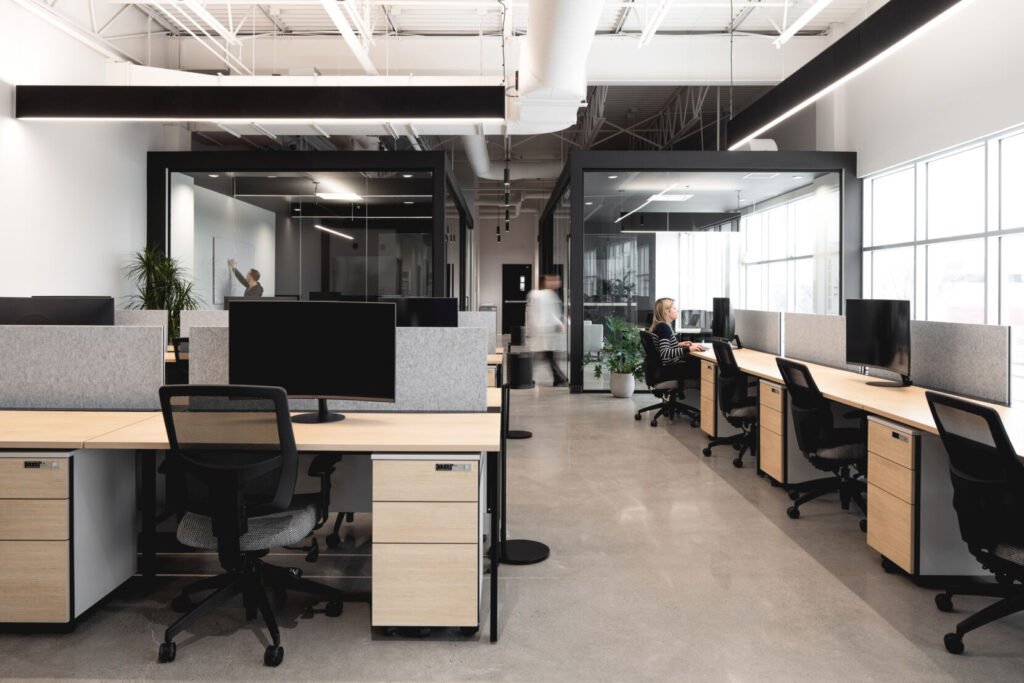
WORKSTATION TYPES & SIZES
Open Workstations (6′ × 6′)
Dimensions: 6 feet wide × 6 feet deep × 54″ height panels
Best For:
- Software development (easy collaboration, quick conversation)
- Sales teams (high energy, constant communication)
- Marketing departments (brainstorming-oriented)
- Startup culture (open, connected environment)
Seat Density: ~85-100 sq ft per station (very efficient)
Typical Pricing:
- Purchase: $800-$1,400 per station
- Monthly Rental: $12-$22 per station
- Annual Subscription: $180-$264 per station
Real Scenario: Phoenix fintech startup, 25 software engineers in a 4,000 sq ft space. Open 6×6 workstations enable team cohesion, quick question-answering, and collaborative problem-solving. Engineers can call out ideas and whiteboard complex solutions visibly.
Pro: Collaboration, space efficiency, startup culture signal
Con: Limited privacy, sound management required, less formal appearance
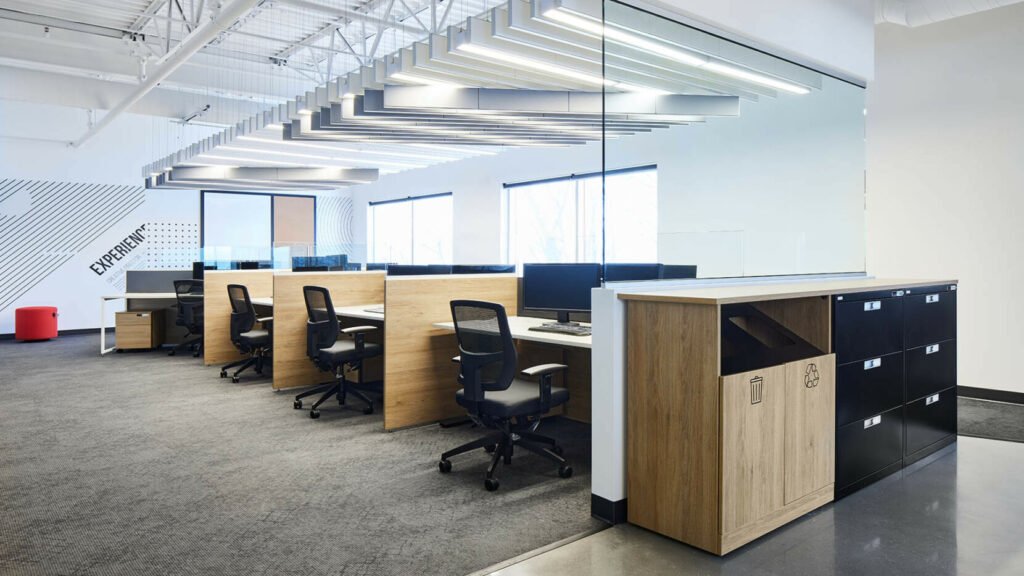
Semi-Private Cubicles (8′ × 8′)
Dimensions: 8 feet wide × 8 feet deep × 54-60″ height panels (higher than open stations)
Best For:
- Accounting/finance teams (confidential data, focus work)
- Legal/compliance teams (privacy important, confidential conversations)
- Customer service teams (call handling, reduced distraction)
- Insurance/real estate teams (client conversations, privacy needed)
Seat Density: ~115-130 sq ft per station
Typical Pricing:
- Purchase: $1,200-$2,000 per station
- Monthly Rental: $18-$32 per station
- Annual Subscription: $270-$450 per station
Real Scenario: Phoenix professional services firm, 30 accountants managing confidential client data. 8×8 cubicles with 60″ panels provide privacy for client calls and sensitive document review while maintaining team proximity. More professional appearance than open for client-facing functions.
Pro: Privacy, focus work support, professional appearance
Con: Reduced collaboration, uses more space, less dynamic energy
Individual Offices (10′ × 10′)
Dimensions: 10 feet wide × 10 feet deep (full height glass or drywall option)
Best For:
- Senior team members (managers, directors, specialists)
- Client-facing roles (designers, consultants requiring confidential space)
- Deep-focus roles (engineering architects, senior analysis)
- Team leads/supervisors (private meetings, team oversight)
Seat Density: ~150-180 sq ft per station
Typical Pricing:
- Purchase: $1,500-$2,800 per station (modular) or $15,000+ per traditional office
- Monthly Rental: $25-$45 per station
- Annual Subscription: $375-$675 per station
Configuration Options:
- Modular full-height walls (professional, flexible, moveable)
- Partial glass walls (collaboration visibility, privacy functionality)
- Full glass (transparency, open feel, modern)
WORKSTATION SCALING SCENARIO: REAL GROWTH EXAMPLE
Client: Phoenix B2B SaaS company
Month 0 (Series Seed Funding): 8 employees in 2,000 sq ft
- Deployed: 10 open workstations (rented at $180/month)
- Total workstation cost: $180/month
Month 6 (Seed Extension): 15 employees, still 2,000 sq ft
- Added: 5 additional workstations
- Workstation cost increased to $270/month
- No capital deployment; no space changes; simply scaled furniture
Month 12 (Series A Funding): 28 employees, expanded to 5,000 sq ft
- Added: 12 workstations
- Reconfigured: Reorganized existing 15 to team clusters
- Workstation cost increased to $480/month
- Total capital saved vs. purchasing: $28,000 (vs. purchasing at $1,000/station average)
Month 18: 35 employees, still 5,000 sq ft
- Reconfiguration: Shifted from open to semi-private (8×8 cubicles)
- Maintained seat count but higher privacy for new operational needs
- Workstation cost stayed similar ($500/month), but privacy increased
Month 24: 38 employees
- Added 3 seats
- Cost: $510/month
- Added 2 management offices from modular office options
Outcome:
- Scaled from 8 to 38 employees
- 4 major reconfigurations supporting team growth
- Never committed capital to chairs/desks
- Monthly cost scaled with headcount, no overpaying for empty seats
- Flexibility to downsize if growth slowed
Total Furniture Cost Over 24 Months (Rental): $7,200 for 38 fully-supported workstations. Equivalent Purchase Cost: $38,000+ (capital now, depreciation ongoing)

WORKSTATION CONFIGURATION PATTERNS
Open Space with Clustered Teams
Layout: Open 6×6 stations arranged in team clusters (engineering cluster, sales cluster, marketing cluster)
Benefits: Collaboration within teams, team identity, and easier management
Best For: Collaborative, dynamic companies (tech, marketing, design)
Organized Grid Pattern
Layout: Semi-private 8×8 cubicles in organized grid (rows/columns)
Benefits: Efficient space utilization, clear team structure, professional appearance
Best For: Professional services, finance, operations teams
Neighborhood Pattern
Layout: Mixed open + semi-private in neighborhoods (small group of 4-6 stations sharing management)
Benefits: Balance collaboration + privacy, flexible team sizing, scalable
Best For: Growing companies transitioning from startup to structured organization
WORKSTATION UPGRADE & RECONFIGURATION
Common Reconfigurations:
- From Open to Semi-Private: Team matures, needs more focused work, privacy increases (add $5-10/month per station for reconfiguration)
- From Grid to Cluster: Organization recognizes team identity, wants physical team proximity (no cost, just rearrangement)
- Add Management Offices: Team grows, first supervisors/team leads emerge (integrate modular offices, maintain overall layout)
- Density Increase: Adding more seats to the same space (move from 8×8 to 6×6 in some areas, increasing efficiency but reducing privacy)
FREQUENTLY ASKED QUESTIONS
Q: What’s the difference between open workstations and cubicles?
A: Open stations (6×6) have 54″ panels, you can see/communicate across. Semi-private cubicles (8×8) have 54-60″ panels, more separation and privacy. Open for collaboration; cubicles for focused work.
Q: Can we mix open and semi-private in the same space?
A: Absolutely. Many companies create “open zones” for collaborative teams and “quiet zones” for focused work. We design neighborhood layouts that blend both.
Q: What if we need to reconfigure—can you move workstations?
A: Yes. Modular furniture is designed for reconfiguration. Most reconfigurations take 1-2 days (depending on the extent). Cost: $200-$500 per reconfiguration, depending on scale. Included in subscription agreements.
Q: How many workstations fit in X square feet?
A: Rule of thumb: ~120 sq ft per open station, ~160 sq ft per semi-private. So: 5,000 sq ft office = ~30-40 workstations, depending on aisles, meeting areas, bathrooms, and break room.
Q: What if we contract—can we remove workstations?
A: Yes. Monthly rental is scaled to the actual seat count. If you reduce from 30 to 25 seats, the monthly cost drops proportionally. No penalty, no stranded capital.
Q: How quickly can you add workstations?
A: Standard is 2-3 weeks if we have inventory. Rush (1 week): possible at premium rate. Long lead times only for custom/specialty configurations.
Related Pages:
- Height Adjustable Desks (workstation upgrades)
- Collaborative Workspace Furniture (breakout/meeting areas)
- Training Room Furniture (if the company has a training function)
- Office Relocation Services (when companies move)
START HERE
Schedule Your Free Workstation Growth Planning Consultation
Understand your current space capacity, project 12-24 month growth, and identify a cost-effective scaling strategy.